
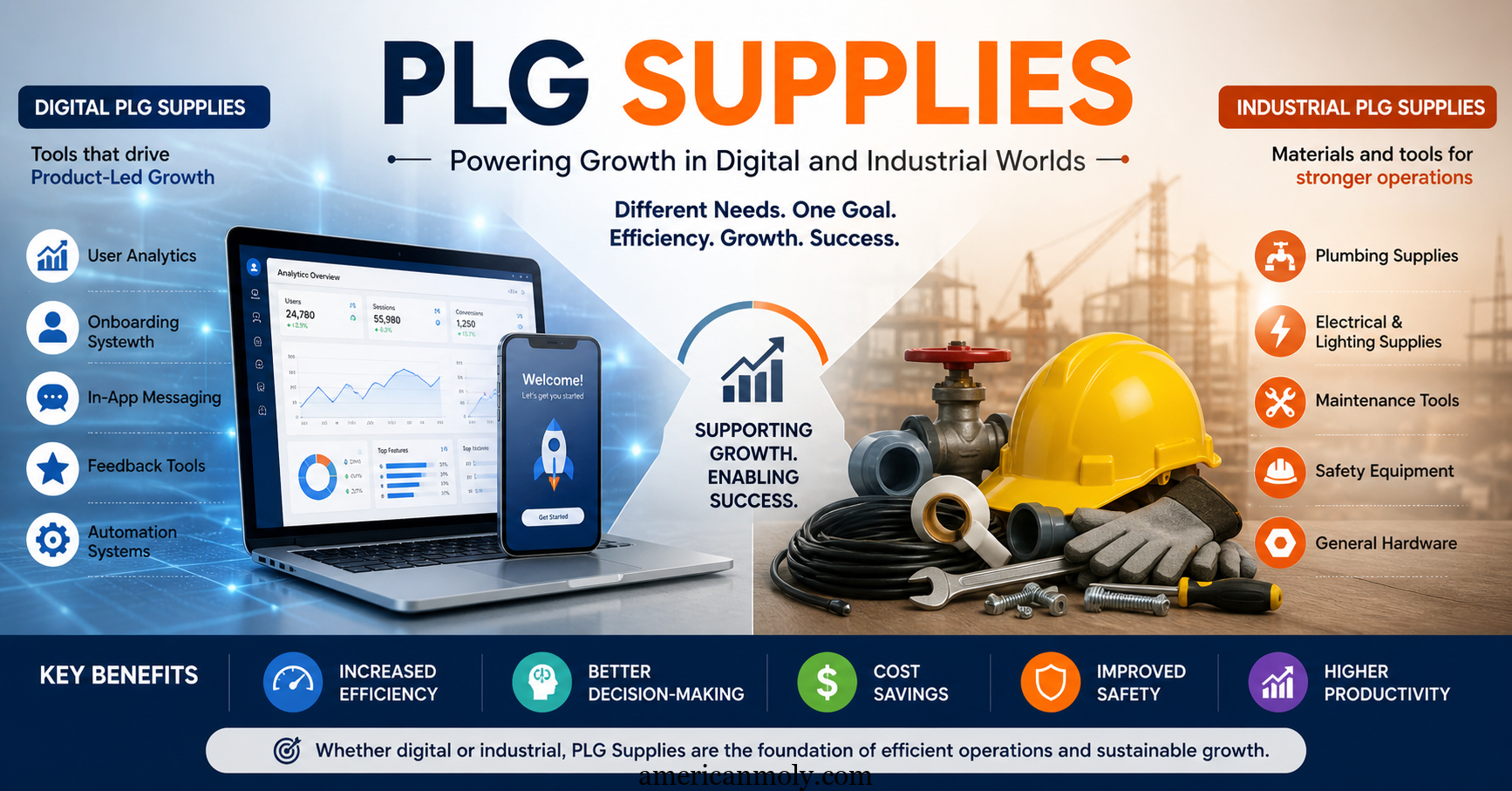
The term PLG Supplies is becoming increasingly important in both digital business environments and traditional industrial sectors. Although it looks like a simple phrase, it actually carries a dual meaning that often confuses readers, business owners, and professionals.
In one context, PLG Supplies refers to Product-Led Growth tools and digital systems used by modern SaaS companies to attract, engage, and retain users. In another context, it refers to physical industrial and operational supplies such as plumbing materials, lighting components, and general maintenance tools.Because these two meanings belong to completely different industries, understanding PLG Supplies requires clarity, context awareness, and practical knowledge.
What Are PLG Supplies
PLG Supplies is not a single fixed category. Instead, it is a flexible term used in two major ways depending on the industry.
Digital Meaning
In the technology and SaaS industry, PLG stands for Product-Led Growth, a modern business model where the product itself becomes the primary driver of customer acquisition, user engagement, retention, and long-term expansion. Instead of relying heavily on traditional sales methods, companies focus on delivering a product experience that naturally attracts and converts users. These include product analytics platforms that track user behaviour, onboarding tools that guide new users through the product, in-app messaging systems that improve communication, customer feedback tools that collect user insights, and automation or CRM systems that streamline marketing and customer management processes.
Industrial Meaning
In construction, manufacturing, plumbing, logistics, and other industrial sectors, PLG Supplies refer to physical goods and materials used in daily operations and maintenance work. These supplies are essential for completing tasks efficiently and keeping projects running smoothly without delays. They include items such as pipes, valves, and fittings for plumbing systems, electrical wiring and lighting components for installations, hand tools and machinery parts for repairs and construction, safety equipment like helmets and gloves, and other maintenance materials needed for regular upkeep.
Why PLG Supplies Are Important
PLG Supplies are essential because they directly support efficiency, productivity, and operational success in both digital and physical environments.
In Digital Businesses
For SaaS companies and tech startups, PLG Supplies (tools) play a crucial role in driving growth and improving product performance. These tools help businesses understand user behaviour through advanced analytics, improve onboarding experiences for new users, increase product adoption rates, and reduce customer acquisition costs by making growth more efficient. Without these essential digital tools, it becomes difficult for companies to scale effectively or fully understand customer needs and expectations.
In Industrial Operations
In construction, manufacturing, and maintenance industries, PLG Supplies are equally important but serve a more physical and operational purpose. They help teams complete projects on time, maintain strict safety standards, and reduce downtime caused by delays or equipment failure. Most importantly, they guarantee system reliability, which is essential for continuous operations. A missing tool or material can disrupt workflow significantly, making PLG Supplies a critical part of industrial productivity and stability.
PLG Supplies in the Digital Product Led Growth Model
Product-Led Growth is one of the fastest-growing business strategies in the modern digital economy, where companies focus on making the product itself valuable, intuitive, and easy to use instead of relying heavily on sales teams or traditional advertising. In this model, key Digital PLG Supplies include essential tools that enhance the overall product experience and support user success.
Onboarding systems guide new users step-by-step so they can quickly understand and start using the product effectively. In-app messaging tools enable real-time communication within the product, offering tips, updates, and helpful notifications. Feedback collection tools gather user opinions and insights, allowing companies to continuously improve product quality. Automation systems further support efficiency by reducing manual effort in marketing, customer support, and user engagement processes.
Industrial PLG Supplies in Real World Operations
| Category | Description | Examples |
| Plumbing Supplies | Used in water and gas systems for installation and repair work | Pipes, joints, valves, seals, connectors |
| Electrical and Lighting Supplies | Used for electrical installations and lighting systems in different environments | Bulbs, wiring, switches, fixtures |
| Maintenance Tools | Essential tools for repairing, assembling, and fixing equipment and structures | Screwdrivers, drills, wrenches, cutters |
| Safety Equipment | Protective gear used to ensure worker safety in high-risk industrial environments | Helmets, gloves, goggles, protective clothing |
| General Hardware | Small but essential components used to build and secure structures | Fasteners, adhesives, nails, screws |
Why the Term PLG Supplies Is Confusing
One of the biggest challenges with the term PLG Supplies is its dual interpretation, which often leads to confusion across different industries. In the technology sector, PLG stands for Product-Led Growth, where PLG Supplies refer to digital tools such as analytics platforms, onboarding systems, and automation software. .
The word supplies naturally suggests physical items, which adds to the misunderstanding when it is used in a digital business context where no tangible goods are involved. As a result, the same term appears in completely different environments, creating ambiguity for readers and professionals. For example, a SaaS company discussing PLG Supplies is usually referring to software tools that improve user experience and product growth, while a construction company using the same term is talking about physical materials required for building and maintenance work.
How Businesses Use PLG Supplies
In technology companies, PLG tools are used to improve overall product experience by making applications more user-friendly and effective. They help businesses track customer journeys in detail, understand how users interact with different features, and identify areas for improvement.On the other hand, in industrial companies, physical PLG Supplies are essential for day-to-day operations.
Without these materials, projects would face delays and operational risks. Although their functions are different, both digital tools and physical supplies are equally important, as both types of businesses depend on PLG Supplies to operate efficiently and achieve long-term success.
Benefits of PLG Supplies
- Increased Efficiency Proper tools and systems make work faster, smoother, and more organised.
- Better Decision-Making Digital PLG tools provide valuable data insights that help businesses make smarter and more informed decisions.
- Cost Savings Using the right supplies reduces waste, prevents errors, and avoids unnecessary or repeated purchases.
- Improved Safety Industrial supplies ensure worker protection and help maintain compliance with safety standards and regulations.
- Higher Productivity Availability of essential resources allows teams to focus on their work without interruptions or delays.
Challenges in PLG Supplies
Despite their importance in both digital and industrial sectors, PLG Supplies come with several challenges that businesses must manage carefully. Rising costs of materials and software tools can increase operational expenses, while supply chain disruptions may cause delays and shortages.
In addition, quality inconsistency among different suppliers can affect performance and reliability, and overdependence on specific vendors may create risks if supply is interrupted. In the digital space, rapid technological changes in tools and platforms also make it difficult for companies to stay updated. Because of these issues, businesses need to carefully plan procurement strategies, evaluate suppliers, and continuously monitor quality to avoid operational problems.
Future of PLG Supplies
The future of PLG Supplies is expected to evolve significantly across both digital and industrial sectors as technology and global industries continue to advance. In the digital world, the future will be shaped by AI-driven analytics tools, smarter onboarding automation, predictive user behaviour tracking, and fully integrated growth platforms that combine multiple functions into a single system.
These innovations will help companies better understand users and improve product performance. In industrial sectors, future developments will include smart inventory systems, eco-friendly materials, automated supply chains, and more sustainable production methods. As these changes take place, PLG Supplies will become more advanced, efficient, and deeply interconnected across industries, supporting smarter and more sustainable business operations.
Conclusion
PLG Supplies is a powerful yet dual-meaning term that plays a major role in both digital and physical industries. In the digital world, it represents tools that support Product-Led Growth strategies. In the industrial world, it represents essential materials used for construction, maintenance, and operations.
Understanding the correct meaning depends entirely on context. Whether you are working in software development or managing physical operations, PLG Supplies remain crucial for efficiency, productivity, and long-term success.








Leave a Reply