
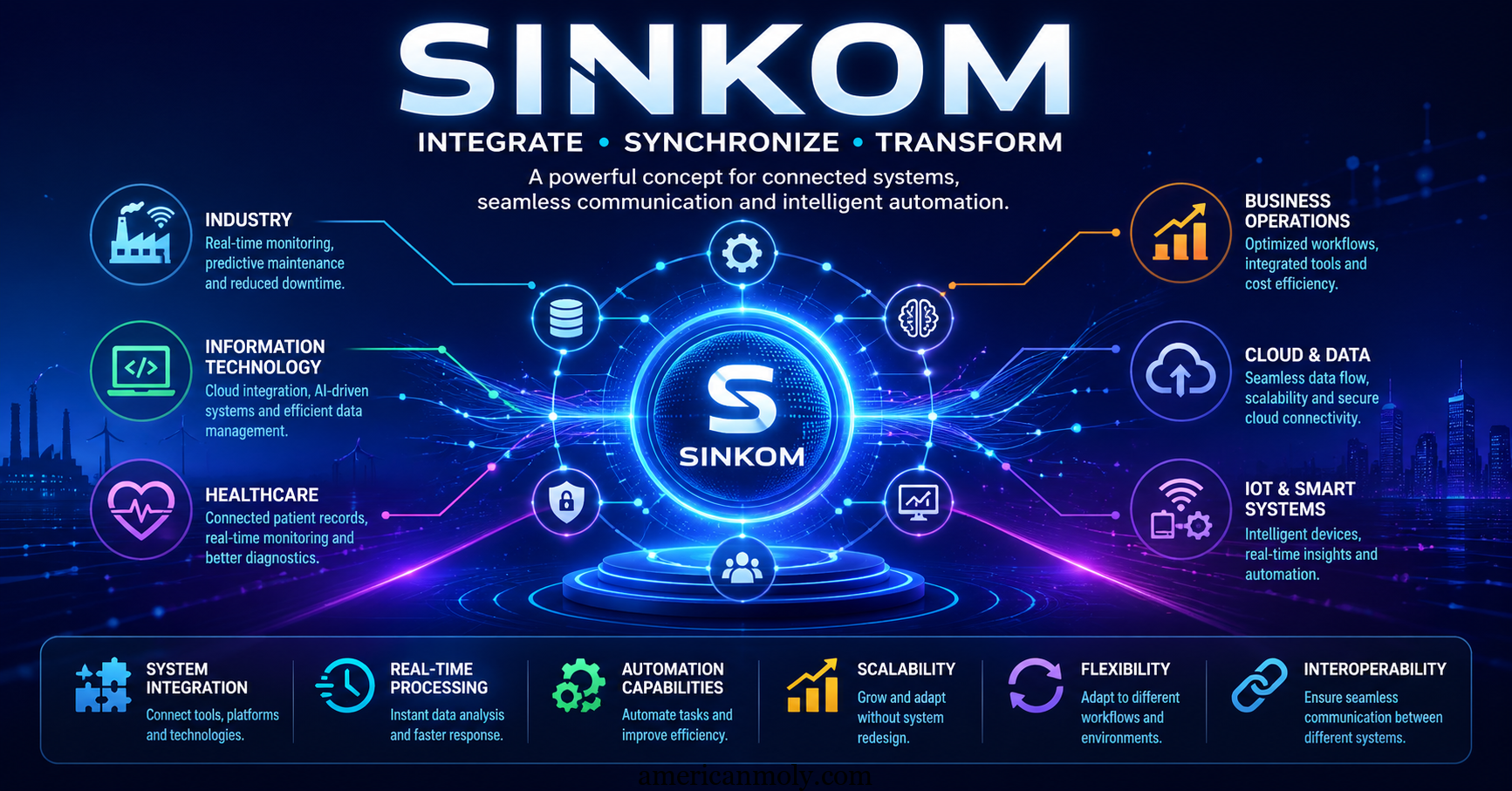
In today rapidly evolving digital and industrial environment, the need for connected, intelligent, and efficient systems has become more important than ever. Organisations, industries, and even everyday users rely on multiple tools, platforms, and technologies that must work together smoothly.
This growing demand for integration has given rise to modern concepts such as Sinkom.widely understood as a framework or conceptual system designed to improve synchronisation, communication, and modular integration across processes and technologies. While it does not refer to a single fixed software or product, it represents an approach to solving one of the biggest challenges in modern systems: fragmentation.As industries grow more complex, Sinkom provides a way to simplify operations, reduce inefficiencies, and improve coordination between systems.
What is Sinkom
Sinkom can be described as a modern integration concept that connects systems, tools, and processes into a unified operational structure. It focuses on ensuring that different components within a system can communicate and function together without disruption.Instead of working in isolation, systems built on principles are designed to be interconnected. This allows data, commands, and processes to flow smoothly across platforms.In simpler terms, Sinkom is about making sure everything works together efficiently rather than separately.
Key Idea of Sinkom
At its core, Sinkom is built on three foundational principles: synchronisation, communication, and modularity. Synchronisation ensures that all processes and systems operate in perfect alignment, reducing delays and avoiding conflicts within operations.
Communication focuses on enabling seamless interaction between different components, allowing data and instructions to flow smoothly across the entire system without disruption. Meanwhile, modular structure provides the flexibility to break complex systems into smaller, manageable units that can be independently developed, upgraded, or scaled according to need.
Origin and Conceptual Background of Sinkom
Although Sinkom does not have a clearly documented origin like traditional technologies, it is generally believed to have emerged from the growing need for system integration and automation in modern environments.
As digital transformation accelerated, businesses and developers began to face challenges related to disconnected tools, inefficient workflows, and lack of real-time communication between systems.emerged as a conceptual response to these challenges.The term itself is often interpreted as a combination of ideas related to:Together, these elements represent the idea of connected and coordinated systems.
Why Sinkom is Becoming Important
The importance of Sinkom lies in its ability to address real-world operational challenges that arise from increasingly complex modern systems. Today’s organisations rely on multiple technologies, platforms, and devices that often operate in isolation, creating inefficiencies and communication gaps. One of the key reasons is becoming more important is the rising complexity of business systems, where companies use numerous software tools that do not always integrate or communicate effectively with one another.
Alongside this, there is a growing demand for automation, as organisations aim to reduce manual effort, streamline workflows, and improve overall productivity. Another critical factor is the need for real-time data access, which allows industries to make faster and more accurate decisions based on up-to-date information.Sinkom plays a vital role in solving all these challenges by creating a more connected, efficient, and intelligent operational ecosystem.
Core Principles of Sinkom
Sinkom operates on several key principles that define how it functions across different systems.
Synchronisation
Synchronisation ensures that all connected systems operate in perfect alignment with one another. It maintains coordinated timelines so that every process follows the same schedule without delays or mismatches. It also supports unified workflows, allowing different departments or system components to work together smoothly as part of a single integrated process. Without proper synchronisation, systems can easily produce conflicting outputs, errors, or operational delays that reduce overall efficiency.
Communication
Communication acts as the backbone of Sinkom, enabling seamless interaction between different systems and components. It allows data to be shared effortlessly between applications, ensuring that information flows smoothly across the entire network. Through inter-system messaging, different tools and platforms can exchange instructions and updates without manual intervention. This creates a transparent information flow where every connected element stays informed and updated. Effective communication not only improves coordination but also significantly reduces misunderstandings, errors, and inefficiencies in operations.
Modularity
Modularity refers to the ability to break complex systems into smaller, independent components that can function separately yet still work together as part of a larger structure. This approach offers several key benefits, including easier system upgrades, as individual modules can be improved without affecting the entire system. Most importantly, modularity reduces the risk of total system failure because if one component stops working, the rest of the system can continue operating without disruption.
How Sinkom Works
- Sinkom operates as a structured system that manages data flow and coordinates actions across multiple interconnected layers.
- Data Collection: Raw data is gathered from various sources such as sensors, tools, and applications.
- Data Processing: The system analyses collected data to identify patterns, detect errors, and uncover opportunities for improvement.
- System Communication: Processed information is shared seamlessly across all connected components within the system.
- Automated Action: Based on processed insights, the system automatically executes decisions or triggers required responses.
- Continuous Feedback: The system learns from outcomes and continuously improves through feedback loops.
- This ongoing cycle ensures continuous optimisation, higher efficiency, and smarter system performance over time.
Applications of Sinkom
Sinkom is not limited to a single field; instead, it is widely applied across various industries to improve efficiency, coordination, and overall system performance.
In the field of information technology, Sinkom supports cloud integration, seamless software communication, AI-driven systems, and efficient data management, making digital ecosystems more connected and intelligent. In healthcare, it plays a crucial role by connecting patient records, enabling real-time health monitoring, improving diagnostic accuracy, and enhancing communication between medical departments, ultimately leading to better patient care. Within business operations, used to improve workflow efficiency, integrate multiple management tools, reduce operational costs, and enhance collaboration between teams.
Key Features of Sinkom
- Sinkom includes several advanced features that make it highly useful across different industries and system environments.
- System Integration It connects multiple tools, platforms, and technologies into one unified and coordinated structure.
- Real-Time Processing Enables instant analysis of data, allowing systems to respond quickly and accurately.
- Automation Capabilities Automates repetitive tasks, reducing manual effort and improving operational efficiency.
- Scalability Allows systems to expand and grow without requiring complete redesign or restructuring.
- Flexibility Can adapt easily to different industries, workflows, and operational environments.
- Interoperability Ensures different technologies and systems can communicate effectively without compatibility issues.
Challenges of Sinkom
Despite its many advantages, Sinkom also comes with certain limitations that can affect its adoption and implementation. One of the main challenges is complex implementation, as integrating Sinkom into existing systems can be difficult, especially in organisations that rely on older or fragmented technologies.
Another limitation is the high initial cost, since setting up the required infrastructure and upgrading systems may require significant financial investment.Compatibility issues can also arise, as older systems may not easily integrate with modern based frameworks. Finally, data security concerns remain important because highly connected systems require strong protection measures to prevent breaches, unauthorized access, or data loss.
Sinkom in Modern Digital Transformation
Sinkom plays a major role in digital transformation strategies. As businesses move toward automation and smart technologies, Sinkom helps bridge the gap between traditional systems and modern digital ecosystems.It enables organisations to:
- Transition smoothly into digital environments
- Improve operational intelligence
- Enhance customer experience
- Increase competitiveness
Future of Sinkom
The future of Sinkom is closely connected with the rapid development of emerging technologies such as Artificial Intelligence (AI), Machine Learning, Cloud Computing, the Internet of Things (IoT), and Edge Computing. As these technologies continue to advance, Sinkom is expected to become more powerful, intelligent, and widely adopted across various industries.
Its role will expand as systems become more interconnected and data-driven, requiring smarter frameworks for coordination and automation. Future developments of Sinkom may include fully autonomous systems that operate with minimal human intervention, predictive automation that anticipates needs before they arise, smarter integration platforms that unify even more complex technologies, and enhanced real-time decision-making capabilities that improve speed and accuracy.
Conclusion
Sinkom represents a powerful and evolving concept focused on integration, synchronisation, and intelligent system communication. It plays a crucial role in improving how modern systems interact, process data, and operate efficiently.
From industrial systems and business operations to healthcare and smart technologies, Sinkom provides a unified approach to solving complexity and improving performance.Ultimately not just a concept it is a direction toward a more connected, efficient, and intelligent world.










Leave a Reply